

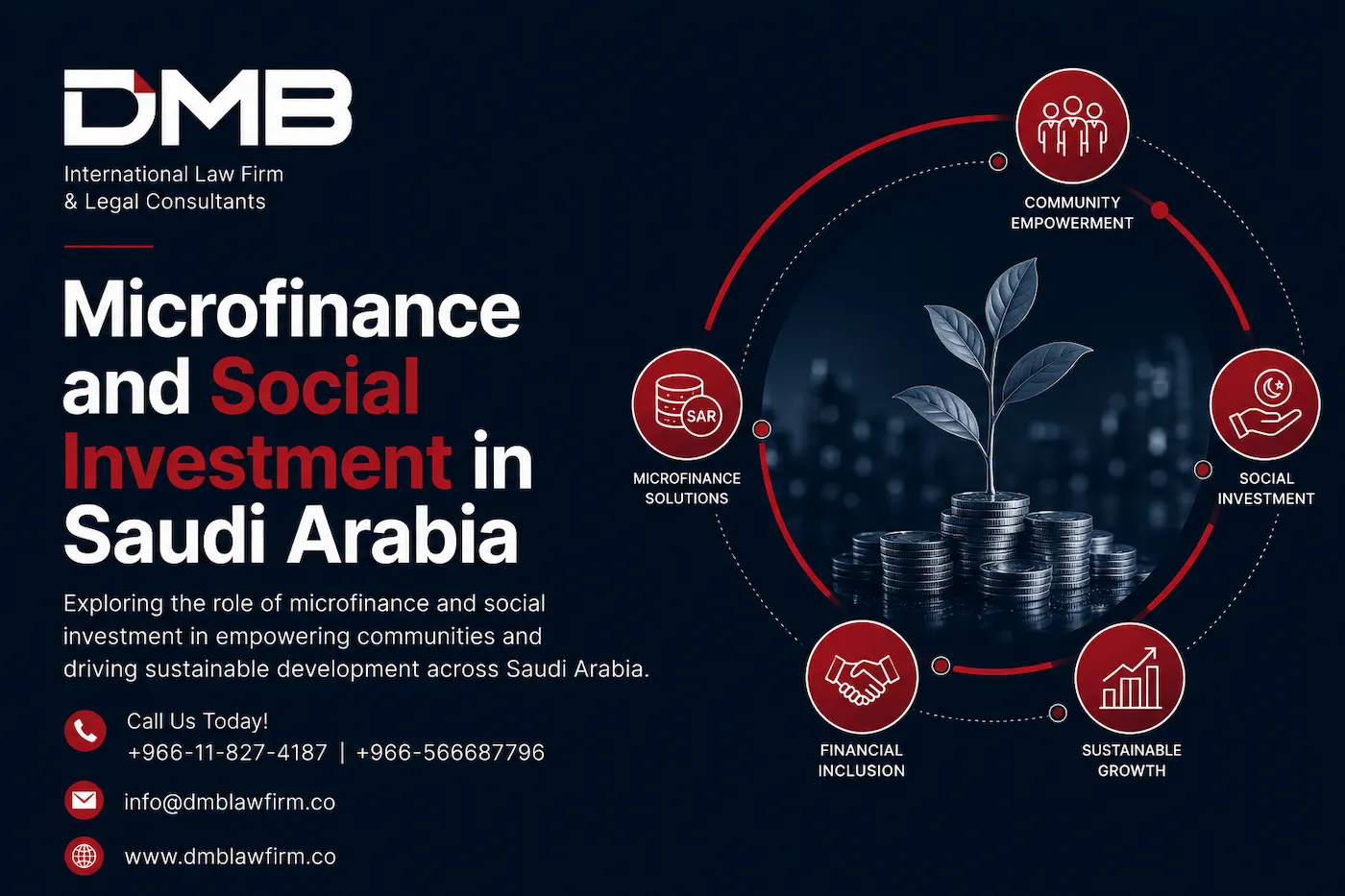
Are you an NGO, fintech, or impact investor trying to understand how microfinance and social investment actually work under Saudi law? This is a common gap — most resources explain the concept but skip the regulatory detail that determines whether a project is even legally viable. Microfinance social investment Saudi Arabia sits at the intersection of finance company regulation, SME support policy, and emerging ESG expectations, and getting the legal structure right from day one matters more than most founders expect.
Microfinance in Saudi Arabia — Overview
Microfinance in the Kingdom typically refers to small-scale financing extended to individuals, micro-enterprises, and SMEs who may not qualify for conventional bank financing. This includes:
- Small business loans and working capital facilities
- Shariah-compliant micro-financing structures (often Murabaha or Tawarruq based)
- SME finance programs supported by government-linked initiatives
SME finance Saudi Arabia has expanded significantly under Vision 2030, as the Kingdom pushes to diversify its economy and increase SME contribution to GDP — making this a growing area for fintechs and non-bank lenders.
Legal and Regulatory Framework (SAMA / SME Authority)
What is the best way to legally structure a microfinance or tamwil saghir alsaudia business in Saudi Arabia? It starts with understanding who regulates what:
- SAMA licenses and supervises non-bank finance companies under the Finance Companies Control Law, which provides the overarching framework for licensing, supervision and regulation of non-bank finance companies, including those offering consumer finance, leasing, SME finance and microfinance.
- SAMA microfinance regulations require licensed finance companies to meet capital, governance, and consumer protection standards before operating.
- The SME Authority (Monsha’at) coordinates broader SME support policy, though actual lending activity remains under SAMA’s licensing perimeter.
- Companies combining payment or financing activity with investment features may face dual oversight from both SAMA and CMA, requiring careful early-stage regulatory planning.
This dual-regulator reality is one of the most overlooked legal risks for fintechs entering this space — a model treated as a simple lending product may unexpectedly trigger CMA jurisdiction if it includes investment or fund-like features.
Social Investment and ESG — Legal Obligations
Istithmar ijtimae alsaudia (social investment) introduces an additional compliance layer beyond standard finance regulation:
- ESG investment KSA legal obligations are still developing, but disclosure expectations are rising for funds marketed with social or impact objectives
- Development funds and impact investors must align fund structuring with CMA’s investment fund frameworks where applicable
- Social investment vehicles claiming Shariah compliance require Shariah board certification, just like other Islamic finance products
- Transparency around fund use, beneficiary impact, and reporting is increasingly expected by both regulators and institutional co-investors
Pros of operating in this space:
- Strong policy support and visibility under Vision 2030
- Growing investor appetite for social and ESG-aligned products
- Access to underserved SME and individual borrower segments
Cons / challenges:
- Regulatory perimeter between SAMA and CMA isn’t always intuitive
- Capital and governance requirements can be demanding for early-stage entities
- ESG disclosure standards are still maturing, creating some compliance uncertainty
Key Opportunities Under Vision 2030
Vision 2030’s financial sector development goals continue to expand the space for microfinance and social investment:
- Growing non-bank finance sector, including consumer finance, leasing, and SME finance companies licensed under SAMA
- Increasing digital financial activity, with digital transactions now representing a large share of overall financial activity in the Kingdom
- New CMA fund frameworks creating more flexible structuring options for institutional and social-impact-oriented investment vehicles
- Expanding fintech sandbox access for early-stage microfinance and social finance products
Why Engage Legal Counsel for Microfinance or Social Investment?
Because the SAMA/CMA regulatory boundary is activity-based, not label-based — a product described as “microfinance” or “social investment” could fall under either regulator, or both, depending on its actual structure.
Who Should Read This?
NGOs designing financing programs, fintechs building microfinance products, and development funds or impact investors structuring social investment vehicles in Saudi Arabia.
When Should You Seek Legal Advice?
Before finalizing your product structure or fund documentation — regulatory classification should be mapped before launch, not after.
Microfinance and social investment in Saudi Arabia
Are regulated primarily through SAMA’s non-bank finance framework, with potential CMA involvement for investment-fund-like structures. ESG and social investment obligations are still evolving but increasingly expected by regulators and investors. Early legal structuring is essential given the activity-based, dual-regulator nature of Saudi financial regulation.
FAQ
What is microfinance in Saudi Arabia?
It’s small-scale financing for individuals, micro-enterprises, and SMEs, typically provided through SAMA-licensed non-bank finance companies.
Who regulates microfinance companies in KSA?
SAMA licenses and supervises non-bank finance companies under the Finance Companies Control Law.
Does social investment require CMA approval?
It depends on the structure — fund-like social investment vehicles may fall under CMA’s investment fund frameworks, separate from SAMA-regulated lending.
Is ESG investment legally regulated in Saudi Arabia?
ESG disclosure standards are still developing, but expectations are rising for funds marketed with social or impact objectives.
Can fintechs offer microfinance products in KSA?
Yes, typically through SAMA licensing or the SAMA Regulatory Sandbox for early-stage products.
What’s the difference between SAMA and CMA jurisdiction here?
SAMA regulates lending and finance company activity; CMA regulates investment funds and securities-related structures — some products trigger both.
For the broader picture, see our Islamic Finance & Vision 2030 guide or return to our Islamic Finance Complete Guide.
Legal Questions About Microfinance or Social Investment in KSA? We Can Help. Contact Us today.





Leave A Comment